
Sitecore shipped the measurement half of AI visibility: SitecoreAI Signals, powered by Scrunch, watches how ChatGPT, Gemini, and Perplexity cite and mention your brand, and turns a meaningful shift into a page you can go edit. It is useful, it is early access, and it quietly decides which changes you get to see.
I argued a few weeks ago that Scrunch solved the serving side of AI visibility and left the seeing side open, and that measurement is worth most when it stays independent of the thing it measures. Signals is the seeing side, now shipped inside SitecoreAI, and it does more than measure. It hands you the page to fix.
What Sitecore shipped
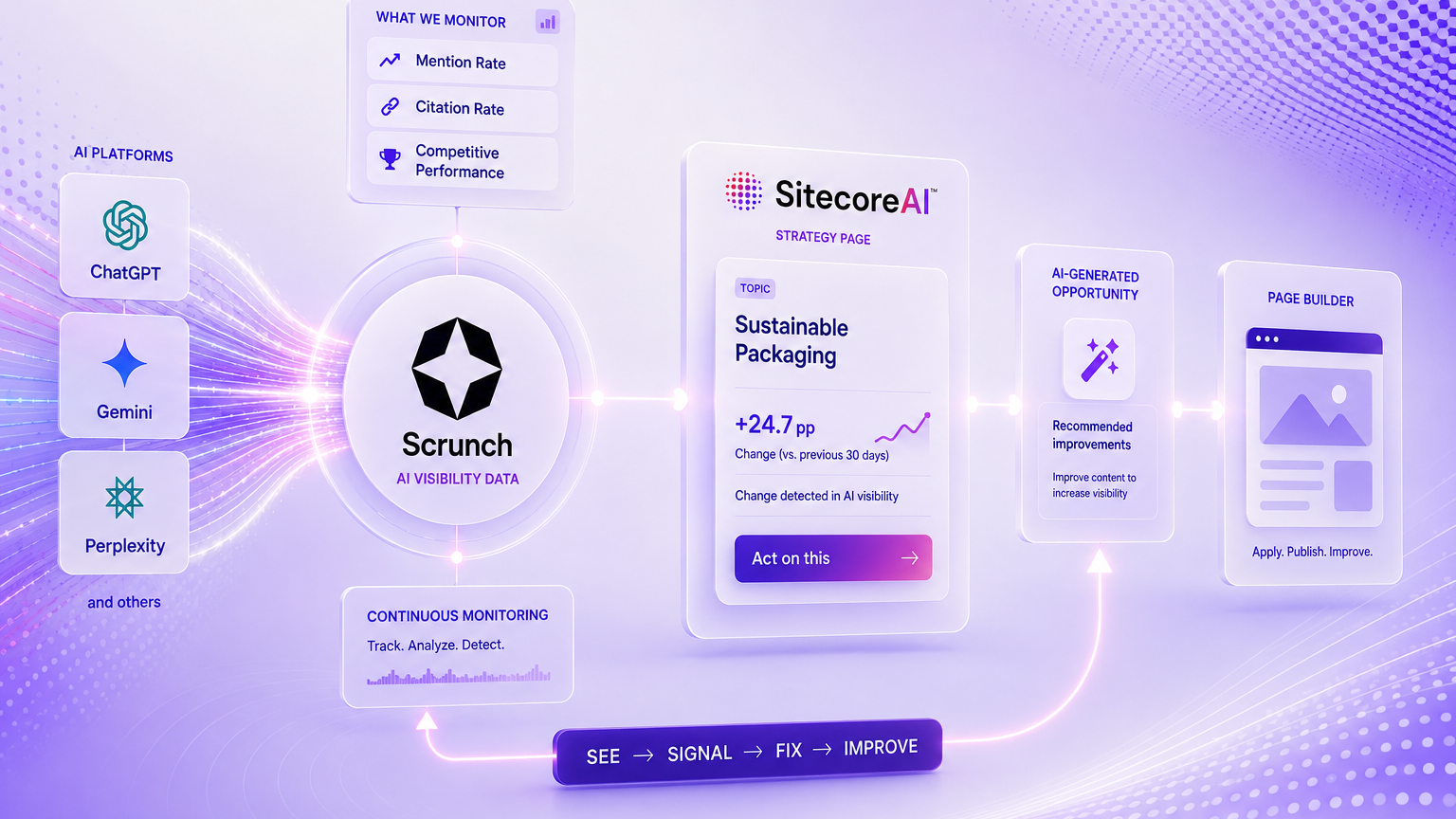
Signals belongs to a new area in SitecoreAI called AI discoverability, powered by Scrunch, and it is early access, gated behind a Scrunch connection and a conversation with your account manager. Once your SitecoreAI environment is connected, a Signals widget appears on the Strategy page. From then on Scrunch watches the major AI platforms, ChatGPT, Gemini, Perplexity, and others, for statistically significant shifts in how your brand is discovered, cited, and mentioned, and when it finds one, SitecoreAI surfaces it as a signal.

A signal is a brand-level insight about a meaningful change, either a sudden shift or a sustained trend, in one of three metrics. Mention rate is how often your brand shows up in AI responses. Citation rate is how often your pages get cited in those responses. Competitive performance is how you move relative to competitors for a topic or on a platform. Each signal card carries a topic, a headline, the size of the change in percentage points, and a button that reads Act on this.
The button is the part that matters. A signal that needs attention can carry an opportunity, an AI-generated recommendation for a small content change to the page the system associates with the shift. You review the recommendation and apply it in the Page builder. All of it happens on one screen, inside SitecoreAI.

The loop closed, and it closed in one place
Until now the pieces of AI visibility lived apart. You served content from your DXP, you measured discovery with a separate tool if you measured it at all, and you decided what to change on your own judgment. Signals folds all three into SitecoreAI. Scrunch, which Sitecore acquired, does the watching. SitecoreAI turns the watch into a signal, the signal into a page-level recommendation, and the recommendation into an edit in the Page builder. The only leg of the loop that sits outside the stack is the AI platforms themselves.
That convenience is the selling point. The friction between noticing a problem and doing something about it was most of the old cost of this work, and Signals removes it. It also removes the distance between the party measuring your visibility and the party selling you the fix, because they are now the same party. I am not raising that as an accusation, the feature is useful, but it is a property of the design worth keeping in view as you use it, and it is the concern I raised when the measurement side was still missing.
The Strategy page is an action queue
There is a quieter design decision underneath Signals, and it changes how you should read the screen. Not every change Scrunch detects becomes a signal in SitecoreAI. Signals are filtered to the ones that are actionable, meaning the ones with specific pages you can go edit. A real shift in your mention rate with no page-level action attached to it may never appear.
So the Strategy page is not a neutral measurement surface. It is an action queue, and it shows you the slice of reality that has a button. That is a defensible product decision, since an endless list of changes you cannot act on would just be noise, but it means Signals answers what can I do in SitecoreAI right now, not how your brand is doing in AI search. If Signals is your only read on AI visibility, you are seeing the actionable subset and calling it the picture.

Using the opportunities without clearing the queue for its own sake
For the marketer the discipline is easy to skip. Apply the change, then watch whether the metric moves, and give it a real window before you decide the edit worked. Signals creates a queue of buttons that feel like progress, and clearing the queue is not the same as improving your standing. Some opportunities will not be actionable at all. Sitecore lists the reasons plainly, the page is not in the CMS, the page sits on a domain the workspace does not manage, or the live content has already drifted from what the recommendation assumed. Those gaps are worth knowing before you tell anyone that Signals covers your whole estate.
For the architect, the integration is a Scrunch connection on the CMS environment, signals rendered on the Strategy page, and a best-effort mapping from a signal to pages you can edit. The mapping is the interesting part, because it is where an outside measurement about your brand has to be resolved back to specific nodes in your content tree, and that resolution is not guaranteed. It is the same seam that runs through the rest of this platform, the outside view and the internal object do not always line up, and where they fail to, the action simply disappears.
What the signal does not tell you
The caveat that matters most is causal, and Sitecore states it in the documentation. The page a signal points at is associated with the change, but the real cause can sit somewhere the platform cannot see, a competitor's campaign, a change in how a model ranks and surfaces sources, an edit you made for unrelated reasons. You can apply the recommended change in good faith and watch nothing happen, because the change was never the lever. The opportunity is a correlation with an Act button on it. It is a lead worth chasing, but it is not a diagnosis, and applying it can leave the metric exactly where it was.
Two more limits are worth stating. Signals is early access, open to select organizations through a Scrunch arrangement, so this describes what a few teams can use now and not a general release. And the metrics are relative and windowed, mention and citation rates over a period, percentage-point moves against a prior window, across a handful of platforms. That is the right shape for spotting movement. It is a thin basis for a target, and I would not turn a percentage-point change on one topic into a KPI without a great deal more underneath it.
The bottom line
Signals is the measurement half of AI visibility, finally shipped, and it is more than a dashboard. It walks you from a detected change to an edited page without leaving SitecoreAI, which is a real gain over a workflow that used to be stitched together by hand. The thing to hold onto is what the convenience costs. The same vendor now serves your content, measures how AI sees it, and recommends the fix, and the screen you read is filtered to the changes that come with a button. Use it as a fast way to find work, then verify with your own eyes that the work paid off. And keep at least one read on AI visibility that Sitecore does not own.
Two questions for your own tenant. When a signal tells you to edit a page, who checks a month later whether the metric moved, or does applying the recommendation just count as done. And do you have any measure of your AI visibility that comes from outside this stack, because if the answer is no, then your serving, your seeing, and your fixing all trace back to one vendor, which is a strong position for them and a blind spot for you.
What's next
Signals gives you the raw material of a real AI-visibility score, mention rate, citation rate, and competitive performance, by topic and by platform, moving over time. What it does not give you is a single defensible number you can govern against, or a way to weigh query coverage, competitive proportion, and citation accuracy into something a board will read. That is the piece I want to write next, a share-of-model score built on metrics like these, with the remediation loop treated as an input to test rather than a source of truth. If you are in the Signals early-access program and have watched a recommended edit either move a metric or fail to, that is exactly the evidence such a score needs, and I would like to compare notes.
References
- Signals, Sitecore documentation, early access, powered by Scrunch: https://doc.sitecore.com/sai/en/users/sitecoreai/ai-discoverability-powered-by-scrunch/signals/signals.html
- Act on your brand's AI visibility changes with SitecoreAI Signals, SitecoreAI changelog, 1 September 2026: https://developers.sitecore.com/changelog/sitecoreai/01092026/act-on-your-brand's-ai-visibility-changes-with-sitecoreai-signals
- AI discoverability powered by Scrunch, Sitecore documentation, early access: https://doc.sitecore.com/sai/en/users/sitecoreai/ai-discoverability-powered-by-scrunch.html
- Connect SitecoreAI CMS to Scrunch: https://doc.sitecore.com/sai/en/users/sitecoreai/ai-discoverability-powered-by-scrunch/connect-sitecoreai-cms-to-scrunch.html
- View signals, and Act on signals: https://doc.sitecore.com/sai/en/users/sitecoreai/ai-discoverability-powered-by-scrunch/signals/view-signals.html
- Scrunch help center, understanding the Signals tab, third-party source: https://helpcenter.scrunchai.com/en/articles/15879296-understanding-the-signals-tab
- My previous post, Two Agents, One Acronym: What Sitecore Bought When It Bought Scrunch: https://www.miguelminoldo.fr/posts/two-agents-one-acronym-what-sitecore-bought-when-it-bought-scrunch
- My previous post, Scrunch Solves Serving. It Doesn't Solve Seeing.
- Companion post, From Brand Kit to Brand Context: SitecoreAI Splits the Brand Into Knowledge and Guidelines