
I've spent the last few days deep in discovery work, building demos and POVs around Sitecore Personalize and CDP for a client evaluating their data strategy. The question kept coming up: "We already have Salesforce. Why would we implement Sitecore CDP on top of that?"
It's a fair question, and the honest answer isn't "because you already have a license as part of SitecoreAI"
This is my attempt to give that question a direct, architectural answer, based on what I've actually seen work and what has created integration debt.
The framing mistake most teams make
When this comparison lands on the table, it usually gets framed as a data question. Which platform holds more data? Which has better segmentation? Which connects to more sources?
That framing misses the point.
The real question is about where activation happens. A CDP's value isn't in data storage, it's in how fast you can move from signal to experience. And that's where the architectural context of Sitecore CDP, sitting natively inside SitecoreAI, starts to matter.
What Sitecore CDP actually is in 2026
Before getting into the comparison, it's worth being precise about what we're comparing.
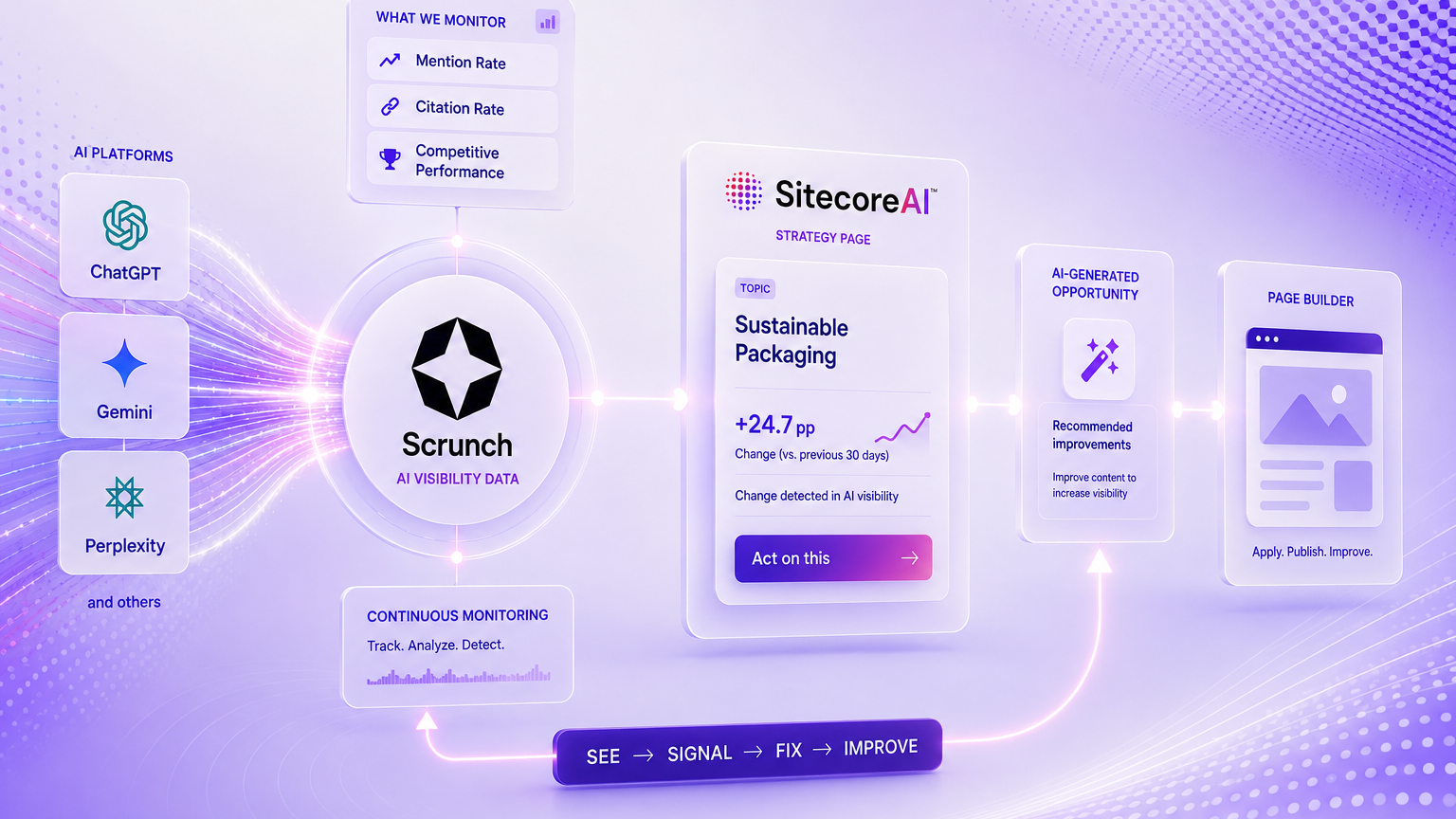
Sitecore CDP is no longer a standalone product you integrate against. As of the SitecoreAI launch in November 2025, CDP and Personalize are embedded inside a unified platform that also includes XM Cloud (now SitecoreAI CMS), Search, Content Hub, and the Agentic and Studios layers. You don't wire CDP to the CMS anymore. They share a data layer by default.
That's a meaningful architectural shift from the composable CDP model of 2022-2023, where you were genuinely assembling an integration from scratch.
If you're evaluating this in isolation, you're evaluating the wrong thing. The question isn't "is Sitecore CDP a better CDP than Segment or mParticle", it's "does native CDP give you advantages that justify not having a best-of-breed standalone?"
Where native wins, clearly
Web behavioral data to personalization, without a pipeline
With a standalone CDP, the typical flow looks like this: your website fires events to the CDP via SDK or tag manager, the CDP processes and segments, you push audience segments back to your CMS or personalization engine via webhook or API, and your CMS applies the experience. There are at minimum three integration points, and each one is a place where latency compounds and things break.
With Sitecore CDP inside SitecoreAI, that flow collapses. Behavioral events captured on your XM Cloud site land directly in the data layer that Personalize reads from. Session context, identified profiles, and real-time decisioning all run inside the same system. The concept of a "sync" doesn't apply, there's nothing to sync.
For web-native personalization use cases (component variants by segment, next-best-content, experimentation), this is a meaningful operational advantage. Fewer failure points, lower latency, and your marketing team operates in one interface.
AI activation through the Marketer MCP and Agent API
This is where the SitecoreAI direction becomes hard to replicate externally. The Marketer MCP server exposes CDP segments, Personalize rules, and content actions as MCP tools that AI agents (Claude, Copilot Studio, Cursor) can call directly. The Agent API abstracts platform operations into business-level commands like create_personalization_version.
If you're building AI-driven workflows, say a content audit agent that triggers personalization updates, or a campaign orchestration agent that reads audience signals and creates page variants, you need your AI layer to talk to your data layer and your content layer in a coherent way. That's much easier when they're the same platform.
With a standalone CDP, you'd build the bridge yourself: custom MCP server, custom API wrappers, custom orchestration. It's doable. But you need to build integration infrastructure.

Where standalone CDPs genuinely win
Being direct about this is important. There are scenarios where a standalone CDP is the better architectural choice, and pretending otherwise doesn't serve anyone.
Omnichannel data unification at scale
Sitecore CDP is strong on web and digital channel data. If your client has a complex multi-channel data landscape, retail POS events, call center data, mobile app streams, IoT signals, complex offline datasets, a purpose-built CDP like Segment, mParticle, or Salesforce Data Cloud has deeper ingestion capabilities, more mature identity resolution across channels, and better tooling for data quality management at enterprise scale.
Sitecore CDP's strength is in activation, not in being a universal data warehouse.
You're already deep in the Salesforce ecosystem
If your client has Salesforce Marketing Cloud, Sales Cloud, and Service Cloud as the core of their MarTech stack, and web is just one channel in a broader customer journey, Salesforce Data Cloud's native integration with that ecosystem is a real advantage. Journeys built in Journey Builder using Data Cloud segments are tighter than anything you'll build through a third-party connector.
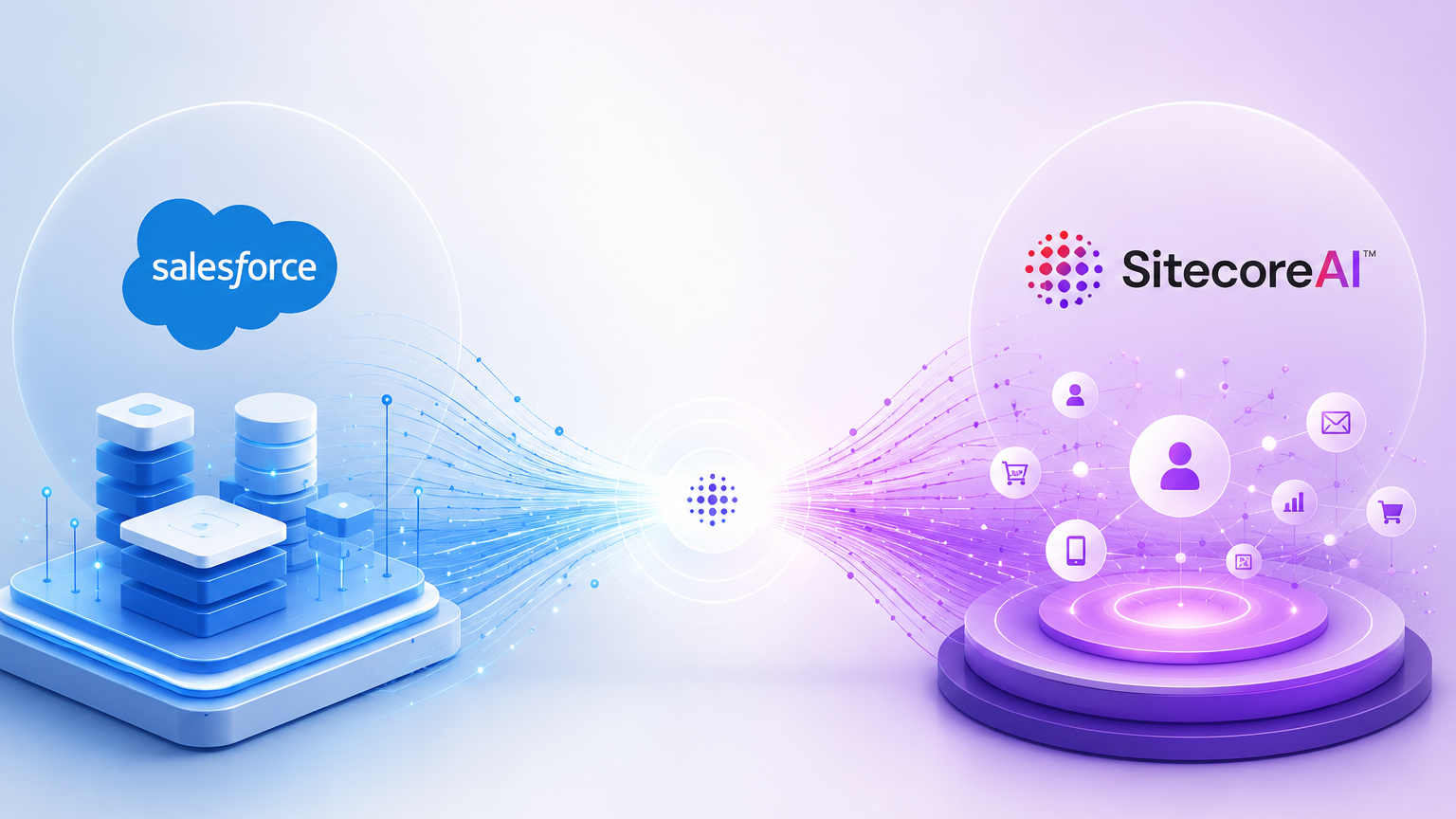
The pattern that actually works in practice is using both: Sitecore CDP for web behavioral data and digital experience activation, Salesforce Data Cloud for CRM-driven journeys and cross-channel orchestration. Not one replacing the other.
Complex regulatory or data residency requirements
Best-of-breed CDPs typically give you more control over data residency, retention policies, and consent management architecture. This matters in regulated industries where your data governance team needs surgical control over where data lives and for how long. Sitecore CDP's SaaS model has improved significantly, but it's still a more opinionated infrastructure than a self-hosted or regionalized enterprise CDP.

The Salesforce CRM integration, specifically
This came up repeatedly in my POV work, so it deserves its own section.
The question is usually one of two things: "We want Salesforce reps to see web behavior" or "We want web personalization driven by Salesforce data."
Salesforce reps seeing web behavior (Sitecore CDP as source of truth)
Sitecore CDP has a native SFMC connector that passes customer identity and segments to Salesforce Marketing Cloud for Journey Builder and audience activation. For pushing behavioral intelligence into Salesforce CRM records, third-party connectors like FuseIT's CDP4S handle the mapping from Sitecore CDP's unstructured behavioral data to Salesforce's structured schema. It works, but it's an integration you own and maintain.
What works well: a prospect browses product pages, downloads a whitepaper, returns twice in a week. CDP builds a propensity signal. That signal gets pushed to the Salesforce contact record. The rep sees it before the call.
What doesn't work as cleanly: bidirectional sync at high frequency. If you want Salesforce field changes to immediately influence Sitecore personalization in real time, you're building a pipeline with latency that matters.
Salesforce data driving web personalization (Salesforce as source of truth)
This is the harder direction. If your client's personalization strategy is "show different content based on the customer's Salesforce account tier or lifecycle stage," you need Salesforce data flowing into Sitecore CDP guest profiles in real time, or near-real time.
This is doable through Sitecore CDP's REST APIs or batch ingestion, but it's integration work. It's not native. The data mapping from Salesforce's structured CRM schema to CDP's identity and attribute model requires deliberate design.
The architectural pattern I'd recommend: use Salesforce as the CRM system of record for account and lifecycle data, use Sitecore CDP as the behavioral and experiential system of record, and define a sync cadence that reflects your actual personalization latency requirements. For most B2B scenarios, a daily or hourly sync on key account attributes is sufficient.
Where SitecoreAI changes the calculus
The architecture I've been describing is still in motion. SitecoreAI's direction, as outlined at Symposium 2025 and expanded at SUGCON 2026, is toward a fully unified intelligence layer, one where CDP data feeds directly into Stream-powered AI agents, and where the Marketer MCP surface covers personalization, content, and measurement in one interface.
That changes the standalone CDP argument in one specific way: the more your team plans to leverage AI-driven workflow automation inside the DXP, the higher the friction cost of a standalone CDP. Because every AI action that touches both content and audience data has to bridge two systems instead of one.
If your client's roadmap is "we want AI agents that autonomously optimize experiences based on behavioral signals," native CDP is the enabling architecture. If their roadmap is "we want better cross-channel journey orchestration with our existing Salesforce investment," a hybrid model makes more sense.

The decision framework

Here's how I'd frame the recommendation in a discovery context:
Choose Sitecore CDP (native) when:
- Your primary personalization use case is web and digital channels within the SitecoreAI ecosystem
- You're migrating from Sitecore XP and need data continuity
- Your team plans to use AI-driven workflows via MCP and Agent API
- You want a single governance and operational context for content, data, and personalization
Consider a standalone CDP (or hybrid) when:
- You have a complex omnichannel data landscape that goes well beyond web
- Your MarTech stack is Salesforce-centric and the journey orchestration complexity lives there
- You need advanced data governance, custom retention policies, or regional data residency
- Your analytics team needs a CDP that serves multiple activation destinations beyond the DXP
Avoid the hybrid trap: Running two CDPs with overlapping scope is expensive and creates profile fragmentation. If you go hybrid, define the boundary clearly: Sitecore CDP owns web behavioral activation, the standalone CDP owns CRM-driven journeys and channel orchestration. No shared profile ownership.
Closing thought
The native tool wins when your primary value chain runs through the DXP. It loses when the DXP is one of many channels and the real customer intelligence lives in your CRM or operational systems.
What's changed in 2026 is that the cost of native is lower than it's ever been, because SitecoreAI has made CDP part of the base platform, not an add-on you negotiate separately. The question isn't whether Sitecore CDP matches Segment feature-for-feature. The question is whether the integration overhead of a standalone CDP justifies the capability delta for your specific use case.
In most DXP-led implementations I've worked on recently, it doesn't.
Have a different experience with standalone CDPs in a Sitecore context? I'd be interested to hear it, especially hybrid architectures where the boundary is well-defined.